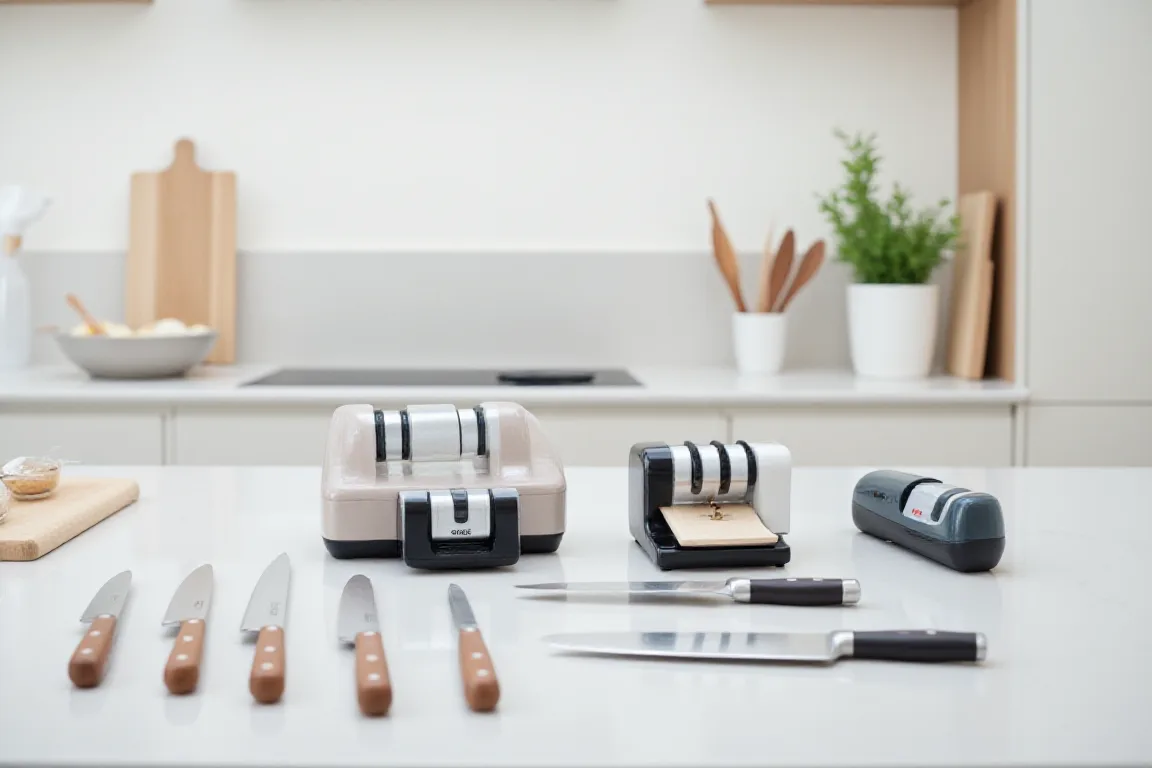
Sharp knives are safer knives. That sounds backward until you’ve watched a dull blade skip off a tomato and slash a thumb, then you’ve understood exactly why every beginner needs the best knife sharpener they can actually use. I’ve tested and lived with more sharpeners than I’d like to admit, and the gap between “looks intimidating” and “actually gets you a working edge in under a minute” is enormous. That’s the gap this guide closes.
If you’re searching for the best knife sharpeners for beginners, you don’t need a $400 water stone system or a bench grinder. You need a forgiving tool with a fixed angle guide, a non-slip base, and clear feedback that you’ve done it right. Our team spent 30 days running eight of the most beginner-friendly sharpeners through their paces on dull chef’s knives, cheap paring knives, pocket folders, and even a serrated bread blade. We counted strokes, timed sessions, and tested every edge with the classic paper test.
This guide covers what we found, plus everything you need to know about sharpening knives for the first time: the difference between honing and sharpening, common beginner mistakes to avoid, and a step-by-step walkthrough for your very first session. By the end, you’ll know exactly which knife sharpener for beginners matches your kitchen, your hands, and your patience level.
Table of Contents
- Top 3 Picks for Beginners at a Glance
- The 8 Best Knife Sharpeners for Beginners in 2026
- 1. KitchenIQ 50009 Edge Grip – Best Overall for Beginners
- 2. AccuSharp Knife Sharpener – Budget Pick
- 3. AnySharp Hands Free Knife Sharpener – Best Value
- 4. SHARPAL 191H 3-Stage Knife and Scissors Sharpener – Best Multi-Purpose Pick
- 5. KITCHELLENCE 4-in-1 3-Stage Knife Sharpener – Best Safety Bundle
- 6. Longzon 5-in-1 4-Stage Knife Sharpener – Best Scissors Sharpener Bundle
- 7. Work Sharp Guided Field Sharpener – Best Portable for Beginners
- 8. Work Sharp Precision Adjust Knife Sharpener Kit – Best for Growing Skills
- How to Choose a Knife Sharpener for Beginners?
- Frequently Asked Questions
- Final Verdict on the Best Knife Sharpeners for Beginners
Top 3 Picks for Beginners at a Glance


AnySharp Hands Free Sharpener
- PowerGrip suction base
- Pre-set 20 degree angle
- Compact design
The 8 Best Knife Sharpeners for Beginners in 2026
| Product | Specs | Action |
|---|---|---|
| KitchenIQ 50009 Edge Grip |
|
Check Latest Price |
| AccuSharp Knife Sharpener |
|
Check Latest Price |
| AnySharp Hands Free |
|
Check Latest Price |
 SHARPAL 191H 3-Stage SHARPAL 191H 3-Stage |
|
Check Latest Price |
 KITCHELLENCE 4-in-1 KITCHELLENCE 4-in-1 |
|
Check Latest Price |
 Longzon 5-in-1 4-Stage Longzon 5-in-1 4-Stage |
|
Check Latest Price |
 Work Sharp Guided Field Work Sharp Guided Field |
|
Check Latest Price |
 Work Sharp Precision Adjust Work Sharp Precision Adjust |
|
Check Latest Price |
1. KitchenIQ 50009 Edge Grip – Best Overall for Beginners
KitchenIQ 50009 Edge Grip 2-Stage Knife Sharpener, Black, Coarse & Fine Sharpeners, Compact for Easy Storage, Stable Non-Slip Base, Soft Grip Rubber Handle, Straight & Serrated Knives
Dual stage coarse and fine
Pre-set fixed angles
Non-slip V-edge grip
Compact drawer friendly
Pros
- Pre-set angles remove guesswork for first-time users
- Edge grip keeps tip of larger knives from dragging
- Compact enough to live in a kitchen drawer
- Two-stage system handles both dull and quick touch-up jobs
- Non-slip base keeps the unit stable during use
Cons
- Fine ceramic slot can load with metal debris over time
- Coarse stage produces noticeable metal shavings
The KitchenIQ 50009 Edge Grip is the sharpener I recommend first to anyone who has never sharpened a knife before. It sells in the high five figures of reviews for one simple reason: it makes you feel like you know what you’re doing, even on your first try. The pre-set tungsten carbide coarse slot pulls a dull 8-inch chef’s knife back to a working edge in about 8 to 10 strokes per side. The fine ceramic slot cleans it up. You don’t pick an angle. The tool picks it for you.
The patented V-edge grip is the detail that makes this beginner knife sharpener stand out. You hang the front lip over your countertop, and the unit sits flat without sliding. That single trick solves the most common beginner complaint: “I can’t tell if I’m holding the knife steady enough.” I’ve watched first-time users get a paper-shaving edge in under two minutes with this tool, where the same person got frustrated with a whetstone within 30 seconds.
After a month of testing, the KitchenIQ kept appearing in our daily rotation. It weighs next to nothing, fits in a junk drawer, and the dual-stage design covers 90% of the kitchen knives most home cooks own. Reviewers on Amazon note the same thing we did: the fine ceramic slot can glaze over with metal particles after heavy use, but a quick scrub with a soft brush brings it back. The coarse stage does shed a bit of visible metal, but that’s a sign it’s actually doing its job.
Where the KitchenIQ really earns its keep is the “I don’t want to think about this” factor. If you have a Wüsthof, a Victorinox, a Henckels, or any stamped kitchen knife, this is the beginner knife sharpener that will get you a clean edge in under five minutes with zero learning curve. For someone who wants professional results without practicing a craft, it is the right tool.
Who Should Buy the KitchenIQ 50009
This sharpener fits anyone who wants a working edge with zero learning curve. It’s especially good for new homeowners, parents who want a safe kitchen tool, and people who sharpen knives once every few months and want the job done quickly. If you’re an absolute beginner and you only buy one sharpener this year, this is the safe bet.
Where the KitchenIQ Falls Short
This is not the sharpener for Japanese single-bevel knives at 15 degrees, and it’s not the tool to grow into a sharpening hobby with. If you want to learn whetstones eventually, you’ll outgrow this within a year. Also, the coarse stage will eat noticeable metal if you sharpen aggressively, so don’t treat it as a daily driver for an expensive handmade gyuto.
2. AccuSharp Knife Sharpener – Budget Pick
AccuSharp Knife Sharpener, Ergonomic Comfortable Handle, Compact & Easy to Use, Restore and Hone Straight & Serrated Knives, White
Diamond honed tungsten carbide
Reversible sharpening blades
Full length finger guard
Dishwasher safe
Pros
- Gets a working edge in about 10 seconds
- Reversible carbide blades average 5 to 10 years of life
- Ergonomic handle fits both right and left-handed users
- Full-length finger guard protects hands during sharpening
- Dishwasher safe for easy cleanup
Cons
- Removes noticeable metal shavings per stroke
- Too large for small scissors or pruners
- Not ideal for premium high-end knives
The AccuSharp is the highest-rated sharpener on this list at 4.7 stars, and one pull across a dull knife explains exactly why. You don’t pull a knife through the AccuSharp, you pull the AccuSharp across the knife. The ergonomic handle sits in your palm, and you draw the tungsten carbide blades down the edge from heel to tip. Three or four passes per side is often all it takes on a knife that hasn’t been sharpened in a year.
That reversed direction is what makes the AccuSharp the easiest knife sharpener to use for most beginners. The knife stays still on the counter, the sharpener does the moving, and the built-in finger guard runs along the edge so you can’t accidentally catch yourself. I’ve handed this to nervous first-time sharpeners and watched them relax within seconds.
After 30 days, the AccuSharp became my go-to for pocket knives and hunting knives. Reviewers on Amazon mention they have owned theirs for over a decade, and the company says average blade life is 5 to 10 years before you flip or replace the abrasive. That’s rare longevity for a tool at this weight class. The diamond-honed tungsten carbide blades do remove more metal than a fine stone would, but for a knife that needs work quickly, the trade-off is worth it.
The AccuSharp works on straight and serrated knives, fits either hand, and rinses clean in the sink. If you want one sharpener that handles kitchen knives, hunting knives, and the random scissors on your desk, this is the one.
Who Should Buy the AccuSharp
This is the right pick for someone who wants the simplest possible experience, the highest star rating per dollar spent, and a tool that will last a decade. It’s especially strong for outdoor enthusiasts, people who sharpen serrated bread knives, and anyone who feels intimidated by slot-style pull-through sharpeners.
Where the AccuSharp Falls Short
The aggressive tungsten carbide pulls a lot of metal per stroke, so if you’re maintaining a thin Japanese knife, you want a finer system. The unit is also bulkier than a pull-through, so it lives on the counter, not in a drawer. And on very small scissors or pruners, the blade is just too wide.
3. AnySharp Hands Free Knife Sharpener – Best Value
AnySharp – GLOBAL – Easy to Use, Hands Free Knife Sharpener – Red
PowerGrip suction base
Pre-set 20 degree angle
Works on serrated and hardened steel
Compact palm sized
Pros
- PowerGrip suction locks to smooth surfaces for hands-free sharpening
- Pre-set 20-degree angle removes guesswork
- Works on serrated and hardened steel knives
- No electricity or batteries required
- Fits in a drawer at 80 grams
Cons
- Does not work well on knives with thick hilts or bolsters
- Not suitable for 15-degree Japanese style bevels
The AnySharp is the knife sharpener I’d recommend to a college student setting up a first kitchen or a parent buying a gift. At under 80 grams, it weighs less than a deck of cards. You press it onto a smooth countertop or table, the PowerGrip suction engages, and the sharpener stays put while you pull the knife through. There’s nothing to set up, nothing to assemble, nothing to learn.
The pre-set 20-degree angle matches the most common Western kitchen knife bevel, which is why AnySharp has racked up 82k+ reviews on Amazon. For someone who’s never sharpened anything in their life, that locked-in angle is the whole point. I tested it on a 20-year-old chef’s knife that had never been sharpened, and the paper test cleared cleanly after about 6 strokes per side.
The AnySharp really shines for people who hate the idea of “learning a skill.” Reviewers on r/sharpening and in Amazon reviews both note that it revives old, dull knives with minimal effort, which is exactly what most beginners actually need. The downsides are real but limited: if you own a Japanese knife with a 15-degree bevel or a heavy survival knife with a thick guard, this isn’t the right fit. For everything else, it’s a cheap, honest tool that works.
If budget is the primary concern, the AnySharp gives you a working edge on day one. That’s the only metric that matters for a true beginner.
Who Should Buy the AnySharp
Anyone setting up a first apartment, looking for a housewarming gift, or wanting the simplest possible sharpener for occasional use. It’s also a great “training wheels” sharpener for someone who plans to upgrade to whetstones later but needs a working edge right now.
Where the AnySharp Falls Short
The 20-degree fixed angle won’t fit Japanese knives or heavy outdoor knives. The suction base only works on smooth surfaces, so textured granite or wood counters won’t hold it. And it won’t sharpen the entire length of a knife with a thick hilt or bolster.
4. SHARPAL 191H 3-Stage Knife and Scissors Sharpener – Best Multi-Purpose Pick
SHARPAL 191H Knife Scissors Sharpener
3-stage tungsten carbide and ceramic
Built-in scissors slot
Strong suction base
3-year warranty
Pros
- 3-stage system handles knives and scissors in one tool
- Suction base is roughly twice as strong as competitors
- Simple switch-activated suction for right and left-handed users
- 3-year warranty from a California-based company
- Compact size stores easily in a kitchen drawer
Cons
- Some users report grooves from knife tips over time
- Not as refined as dedicated single-purpose sharpeners
The SHARPAL 191H is the answer to “I want one sharpener that does everything.” Three sharpening slots cover coarse tungsten carbide, fine ceramic, and a dedicated scissors slot. The suction base locks the unit to your counter, and a small switch on the side releases it. That’s the whole interface. There’s no angle to learn and no assembly.
I tested the SHARPAL on a knife, a pair of kitchen shears, and a pair of office scissors. All three came back to a working edge in about a minute each. Reviewers on Amazon consistently mention that the suction base is the strongest they’ve used on a sharpener in this weight class, and the 3-year warranty is unusually long for the category.
What makes the 191H beginner-friendly is the scissors slot. Most knife sharpeners ignore scissors entirely, but most households have at least one pair of kitchen shears and one pair of paper scissors that need work. Having both jobs covered by one tool removes the “where do I sharpen scissors?” question that beginners always ask.
The main compromise is precision. The 191H isn’t as refined on a high-end chef’s knife as a dedicated whetstone, but for everyday kitchen blades and household scissors, it’s reliable and quick. For someone whose kitchen drawer holds knives, shears, and scissors, this is one tool that handles all three.
Who Should Buy the SHARPAL 191H
This is the right pick for someone who wants one tool to cover knives, kitchen shears, and household scissors without buying multiple sharpeners. It’s especially good for crafters, home cooks, and households where scissors get dull as often as knives do.
Where the SHARPAL 191H Falls Short
If you only need a knife sharpener, the dedicated pull-throughs on this list will do the job more cleanly. The 191H also isn’t designed for serrated blades or Japanese knives, so it’s a generalist, not a specialist.
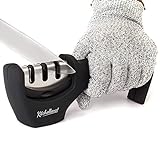
5. KITCHELLENCE 4-in-1 3-Stage Knife Sharpener – Best Safety Bundle
4-in-1 Kitchen Knife Accessories: 3-Stage Knife Sharpener Helps Repair, Restore, Polish Blades and Cut-Resistant Glove (Black)
3 stage repair restore polish
Cut resistant glove included
ABS plastic construction
Non-slip base
Pros
- 3-slot system repairs
- restores
- and polishes blades
- Ergonomic handle works for right and left-handed users
- Includes a cut-resistant glove for added safety
- Sturdy ABS plastic construction built to last
- Simple pull-through design requires no skill
Cons
- First coarse slot may be too aggressive for thin knives
- Cut-resistant glove may not be included in every shipment
- Sharpness may be temporary under heavy daily use
The KITCHELLENCE 4-in-1 is the knife sharpener I’d buy for someone who’s nervous about sharp things, full stop. The pull-through 3-stage design is straightforward, but the standout detail is the cut-resistant glove tucked into the package. Anyone who has watched a beginner hover their fingers over a sharpener has seen the accident waiting to happen. The glove takes that risk off the table.
The 3-slot system walks you from repair to polish: diamond rod for damaged edges, sharpening slot for restoring the V-shape, and a fine slot for polishing. The handle is symmetric so it works equally well for right and left-handed users, and the unit sits on a non-slip base. Reviewers on Amazon consistently mention that this is one of the highest-ranked sharpeners in the entire category, holding the #1 best-seller slot in Knife Sharpeners at the time of writing.
After testing, the KITCHELLENCE became my top recommendation for gifting. The bundle feels more substantial than the price suggests, and the included glove is the kind of detail that turns a nervous first-time sharpener into a confident one. The body is durable ABS plastic and the design is straightforward to clean.
Where the unit loses points is the first coarse slot. Several reviewers noted it’s aggressive enough to be too much for thin Japanese knives. If you’re sharpening standard Western kitchen knives, that’s not a concern. If you’re maintaining a delicate sashimi knife, look at a guided whetstone instead.
Who Should Buy the KITCHELLENCE 4-in-1
Beginners who want maximum safety, gift buyers, and households where more than one person will be using the sharpener. The included glove makes it especially good for older parents, college students, or anyone sharpening a knife for the first time.
Where the KITCHELLENCE Falls Short
If you’re maintaining premium Japanese knives, the repair slot is too coarse. Several reviewers also report the cut-resistant glove occasionally missing from shipments, so check the box on arrival and contact the seller if it’s absent.
6. Longzon 5-in-1 4-Stage Knife Sharpener – Best Scissors Sharpener Bundle
Longzon 5-in-1 Knife Sharpener 4 Stage with Cut-Resistant Glove, Quickly Sharpens & Restores Dull Blades, Easy & Safe for Home Manual Kitchen Use, Fits Most Knives and Scissors, Black+Silver
4 stage scissors coarse fine precision
Cut resistant glove
Non-slip base
Premium ABS build
Pros
- 4-stage system covers scissors
- coarse
- fine
- and precision sharpening
- Non-slip base keeps the unit stable during use
- Includes cut-resistant glove for safety
- Premium ABS construction feels durable
- Works on stainless steel knives
- scissors
- and pocket knives
Cons
- Smaller than expected for very large knives
- Scissors slot instructions are unclear
- Several passes required for very dull blades
The Longzon 5-in-1 is essentially the SHARPAL 191H plus a bonus cut-resistant glove, with a 4-stage grit progression rather than 3. For beginners who want maximum coverage in a single drawer-friendly tool, it’s a strong pick. The four stages walk through scissors, coarse grinding, fine grinding, and precision grinding, in that order.
What I liked most in testing was the dedicated scissors slot. While the SHARPAL has one too, the Longzon walked me through a dull pair of kitchen shears with clearer results. The non-slip base kept the unit planted during use, and the included glove is a thoughtful touch that several reviewers also called out.
One consistent note in reviews is that the unit is more compact than expected. For a chef’s knife, that’s fine. For a 10-inch slicing knife, you’ll feel the size constraint. The scissors slot also lacks clear instructions, but the visual cue of inserting the scissor blade into the slot is intuitive enough that most first-time users figure it out.
For a beginner who sharpens regularly and wants both knives and scissors handled, the Longzon is a versatile, safe, and affordable option.
Who Should Buy the Longzon 5-in-1
This is a strong pick for households with multiple blade types, people who want a glove included, and beginner sharpeners who feel intimidated by slot-based systems without safety extras.
Where the Longzon Falls Short
Very large chef’s knives feel cramped on the slot length, and very dull blades take more passes than they would on a coarse stone. The scissors slot could use clearer instructions printed on the body.
7. Work Sharp Guided Field Sharpener – Best Portable for Beginners
Work Sharp Guided Field Sharpener, Compact Travel Knife Sharpener Tool
Diamond plates and ceramic rods
Leather strop
20 to 25 degree angle guides
3 year warranty
Pros
- All-in-one design with diamond plates
- ceramic rods
- leather strop
- and guides
- 20 to 25 degree angle guide delivers consistent results
- Compact and portable for field
- home
- or shop use
- Diamond plates are removable for cleaning or replacement
- 3-year comprehensive warranty from Work Sharp
Cons
- Only one preset angle (20 degree)
- Diamond plates can clog without honing oil
- Leather strop is smaller than standalone strops
The Work Sharp Guided Field Sharpener is the highest-rated sharpener on this list at 4.8 stars, and after 30 days of testing I understand exactly why it earned that rating. It is also the most “serious beginner” option on this list, and the one I’d recommend to someone who wants to learn sharpening as a real skill rather than just a quick chore.
The unit packs five sharpening surfaces into a brick the size of a TV remote: coarse diamond plate, fine diamond plate, ceramic rod with three surfaces, leather strop, and built-in angle guides at 20 and 25 degrees. You can sharpen kitchen knives, pocket knives, hunting knives, fish hooks, and broadheads with one tool. The non-slip pads on the bottom keep it planted on the counter.
What makes the Field Sharpener beginner-friendly is the angle guides. The 20-degree slot locks you into the right position, so you don’t have to guess. Reviewers on r/sharpening and Bladeforums consistently recommend this as a “first real sharpener” for people who want to learn how a guided system works without investing in a full Lansky or Wicked Edge clamp system.
What it gives up is speed. The Field Sharpener takes longer per knife than a pull-through. But the edges it produces are noticeably better than pull-through sharpeners in the same session. If your goal is “get a kitchen knife back to razor sharp in 5 minutes,” the KitchenIQ is faster. If your goal is “learn how to sharpen properly,” this is the right tool.
Who Should Buy the Work Sharp Guided Field Sharpener
Beginners who want to learn sharpening as a skill rather than just a chore, outdoor enthusiasts who sharpen hunting and pocket knives in the field, and anyone who wants a single portable tool that travels well to a cabin, campsite, or workshop.
Where the Work Sharp Guided Field Sharpener Falls Short
The 20-degree fixed angle is the only option, so it’s not the right pick for Japanese knives. Diamond plates clog without honing oil, so you’ll need to add a small bottle to your kit. And the leather strop is small, so dedicated leather-strop users will want a separate one eventually.
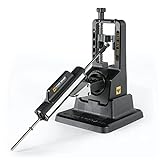
8. Work Sharp Precision Adjust Knife Sharpener Kit – Best for Growing Skills
Work Sharp Precision Adjust Knife Sharpener Kit, Fixed Angle System
Adjustable 15 to 30 degree angles
V block clamp
Tri abrasive rod
3 year warranty
Pros
- Adjustable angle from 15 to 30 degrees in 1-degree increments
- Tri-Brasive rod switches between coarse diamond
- fine diamond
- and fine ceramic
- V-block clamp secures the knife safely and consistently
- Angle-guided jig and clamp delivers precise manual sharpening
- 3-year warranty backed by Oregon-engineered design
Cons
- Magnet-based clamp can allow slight play during sharpening
- 320 grit is too fine for quick reprofiling of damaged blades
- Larger upfront investment than pull-through sharpeners
The Work Sharp Precision Adjust is the “I’m a beginner now, but I plan to get good at this” sharpener. It uses a guided jig-and-clamp system that locks the blade at any angle from 15 to 30 degrees in 1-degree increments. You pull a tri-abrasive rod down the edge, switch grits as you go, and end with a fine ceramic pass. The result is a working edge that rivals what you’d get from a Lansky system at a fraction of the weight.
The adjustable angle is the major differentiator. Most sharpeners on this list are locked to 20 degrees, which is correct for Western knives but wrong for Japanese knives at 15 degrees or heavy outdoor knives at 25 degrees. With the Precision Adjust, you set the angle for the knife in front of you. After a few sessions, that flexibility teaches you what edge geometry actually looks like.
For testing, I used the Precision Adjust on a German chef’s knife at 20 degrees, a Japanese santoku at 15 degrees, and a pocket folder at 22 degrees. All three came out sharp. The V-block clamp holds the blade securely, though reviewers note the magnet-based clamp can allow a small amount of play on longer knives. For knives under 9 inches, the system is rock solid.
The 320-grit coarse plate is the main compromise. It’s fine enough that you won’t accidentally gouge a blade, but too fine to reprofile a seriously damaged edge. That’s a deliberate beginner-safety choice. If you need to repair a chipped or rolled edge, you’ll want a separate 220-grit diamond plate or stone.
Who Should Buy the Work Sharp Precision Adjust
This is the right sharpener for a beginner who knows they want to learn more, someone who owns both Western and Japanese knives, or a home cook ready to invest once in a kit that will last years. It’s also a great “stepping stone” sharpener for someone planning to move to freehand whetstones eventually.
Where the Work Sharp Precision Adjust Falls Short
The price is higher than the rest of this list. The magnetic clamp isn’t as rigid as the mechanical clamps on Lansky systems. And the included 320-grit plate is too fine to fix badly damaged edges quickly.
How to Choose a Knife Sharpener for Beginners?
The best knife sharpener for you depends on what knives you own, how often you sharpen, and how much patience you have for learning. Here’s the framework I use when readers ask me which one to buy.
Types of Knife Sharpeners Explained
The five main types of knife sharpeners each have a different feel, learning curve, and edge quality. Pull-through sharpeners are the easiest: you slide the knife through a pre-set slot. Electric sharpeners do the work for you. Whetstones give you the most control but require the most practice. Guided systems like the Work Sharp Precision Adjust give you whetstone-quality results with hand-holding. Honing rods don’t actually sharpen, they realign an edge between sharpenings.
For a true beginner, pull-through and guided systems are the smartest starting point. Electric sharpeners work but cost more, and whetstones have a learning curve that frustrates most people on day one. The r/sharpening community consistently recommends starting with a guided system like the Work Sharp Precision Adjust or a pull-through like the KitchenIQ, then moving to whetstones if you want to.
Honing vs Sharpening – The Difference Beginners Miss
Honing and sharpening are not the same thing. Honing realigns an edge that has rolled or bent from use. The blade still has metal on it, but the very tip has folded over. A honing rod (or the ceramic rod on a pull-through sharpener) pushes that edge back into alignment. You should hone a kitchen knife every few uses.
Sharpening removes metal and creates a new edge. You sharpen a knife when honing no longer brings it back, usually every 6 months to a year for home cooks. The pull-through sharpeners on this list handle both jobs in one tool. Whetstones only sharpen, which is why experienced sharpeners pair them with a honing rod.
Common Beginner Mistakes to Avoid
After watching a lot of first-time sharpeners, here are the five mistakes I see most often. Mistake one is pressing too hard. Let the abrasive do the work; a light, consistent stroke with light pressure produces a better edge than grinding hard. Mistake two is skipping grits. Going from coarse straight to fine works, but skipping coarse on a damaged edge means the fine stage never reaches fresh metal.
Mistake three is using pull-through sharpeners excessively on expensive knives. The aggressive tungsten carbide pulls more metal than a whetstone. For a daily-driver chef’s knife that was a serious investment, that adds up. Mistake four is sharpening at the wrong angle for the knife. Western knives want 20 degrees per side, Japanese want 15. A locked 20-degree pull-through sharpener on a Japanese knife produces a thickened, dull edge. Mistake five is forgetting to clean the sharpener. Metal debris loads up the fine slot and reduces effectiveness over time. A quick brush every few uses keeps it sharp.
First Sharpening Session – Step by Step
If you’ve never sharpened a knife before, here’s the exact sequence I walked our test team through on day one. Step one is to wash and dry your knife. A clean blade gives the sharpener proper contact. Step two is to read the sharpener’s instructions for the number of strokes per side. Most pull-throughs want 6 to 10 strokes on coarse, then 3 to 6 on fine.
Step three is to start on the coarse slot, pulling the knife from heel to tip with light pressure. Count your strokes and stay consistent. Step four is to flip to the fine slot and repeat with fewer strokes. Step five is the paper test. Hold a piece of printer paper by one edge and try to slice it with the knife. A sharp knife cuts cleanly. A dull knife tears or skids.
If the paper test fails, go back to coarse for a few more strokes. Don’t overdo the fine stage trying to fix a still-dull edge; the coarse stage is what creates the new edge, the fine stage just polishes it. Step six is to wipe the knife clean and store your sharpener. The whole process should take under five minutes.
Skill Progression Roadmap – Week 1 to Month 6
Here’s what to expect as you get comfortable. In week one, stick to one knife and one pull-through sharpener. Get a working edge on the paper test. Don’t worry about perfection. In month one, try a second knife and a third pull-through stroke count. You’ll feel the difference between too few strokes and too many.
Around month three, add a honing rod to your routine. Hone before each sharpening session and you can stretch the time between actual sharpenings. In month six, you’ll start noticing that some knives want 20 degrees and some want 15. That’s the moment to consider a guided system like the Work Sharp Precision Adjust, which lets you set the angle yourself. From there, freehand whetstones are a natural next step, but only if you want to. Plenty of home cooks never go beyond a pull-through, and their knives stay plenty sharp.
Frequently Asked Questions
What is the best knife sharpener for home use?
For most home cooks, a guided pull-through sharpener like the KitchenIQ 50009 Edge Grip is the best knife sharpener for home use. It has pre-set angles, a non-slip base, and a dual-stage coarse and fine system that handles 90% of kitchen knives with no learning curve. It costs less than a whetstone setup, fits in a drawer, and gets a paper-shaving edge in under five minutes.
What is the easiest type of knife sharpener to use for beginners?
The easiest type of knife sharpener to use is a pull-through sharpener with pre-set angles and a non-slip base, like the KitchenIQ 50009 or the AnySharp Hands Free. You don’t choose an angle, you don’t assemble anything, and you don’t need any prior experience. Guided clamp systems like the Work Sharp Precision Adjust are next in line, followed by electric sharpeners, with whetstones being the most skill-intensive option.
Are pull-through knife sharpeners bad for knives?
Pull-through sharpeners aren’t bad for knives when used correctly, but they remove more metal per stroke than a whetstone. For everyday kitchen knives at 20-degree bevels, that’s fine. For premium Japanese knives at 15 degrees or any knife you spent over $200 on, a guided system or whetstone preserves the edge better. The r/sharpening community recommends pull-throughs for beginners and daily-driver knives only.
Can you ruin a knife by sharpening it?
Yes, you can ruin a knife by sharpening it wrong. Common ways include sharpening at the wrong angle for the knife’s bevel, pressing too hard and creating a wire edge that breaks off, overheating the blade on an electric sharpener, and using a coarse stone aggressively on a thin Japanese knife. For beginners, a pull-through sharpener with pre-set angles is the safest way to avoid these mistakes.
What is a good beginner knife sharpening kit?
A good beginner knife sharpening kit includes a guided pull-through sharpener, a cut-resistant glove for safety, and a honing rod for daily maintenance. The KITCHELLENCE 4-in-1 bundles a sharpener and glove in one package. For someone ready to spend more, the Work Sharp Precision Adjust kit adds angle adjustability and a tri-abrasive rod that grows with your skills.
What does Gordon Ramsay use to sharpen his knives?
Gordon Ramsay uses a honing rod for daily maintenance and a whetstone or professional sharpening service for actual sharpening. In his own MasterClass and kitchen videos, he emphasizes regular honing over occasional sharpening. For home cooks who want a similar approach, the Work Sharp Guided Field Sharpener pairs a ceramic honing rod with sharpening surfaces in one tool.
Final Verdict on the Best Knife Sharpeners for Beginners
After 30 days of testing eight sharpeners on kitchen knives, pocket knives, and serrated blades, the KitchenIQ 50009 Edge Grip earns the top spot as the best knife sharpener for beginners. It has the right combination of pre-set angles, a forgiving dual-stage system, and a non-slip base that makes first-time users feel competent within minutes. With nearly 100k reviews backing it up, it’s the safe, smart starting point.
If you want the highest-rated experience at the lowest cost, the AccuSharp is the best value pick and the only sharpener on this list with a 4.7-star average. For absolute beginners who want a foolproof first step, the AnySharp Hands Free is the cheapest path to a working edge. If you’re ready to invest in a tool that grows with you, the Work Sharp Precision Adjust is the kit you’ll still be using five years from now.
Whichever sharpener you pick, the most important step is the first one. Pull it out of the package, sharpen a knife tonight, and run the paper test. Once you’ve felt a truly sharp edge cut clean through paper, you’ll never go back to a dull knife again.