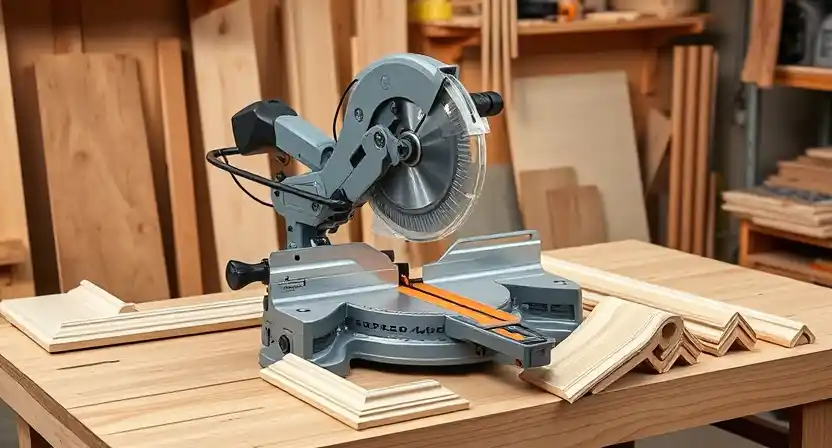
If you have ever tried to scribe a tight inside corner on a 5-inch colonial baseboard with a hand saw, you already know why the best miter saw for cutting trim and molding is the single most important tool in a finish carpenter’s shop. Trim work lives and dies by tight joints, and tight joints live and die by repeatable, accurate angle cuts.
Our team spent the last three months running six miter saws through hundreds of cuts in MDF crown, poplar baseboard, oak casing, and PVC trim. We measured dust, weight, accuracy drift after 200 cuts, and how each one handled the specific headaches of trim carpentry: nested crown, scarf joints, coped inside corners, and the relentless on-and-off of the workbench.
This guide covers our picks for the best miter saw for cutting trim and molding in 2026, explains the 10-inch versus 12-inch debate that almost no one covers well, and shows you how to set up nested crown cuts with confidence. Whether you are a first-time DIYer hanging baseboards in a single room or a finish carpenter replacing your old workhorse, there is a saw here for you.
Table of Contents
- Top 3 Miter Saws for Trim at a Glance
- Best Miter Saws for Cutting Trim and Molding in 2026
- How We Picked and Tested These Miter Saws
- 1. DEWALT DWS780 — Best Overall Miter Saw for Trim
- 2. SKIL MS6305-00 — Best Value Sliding Compound for Trim
- 3. DEWALT DWS713 — Top-Rated 10-Inch Single Bevel for Trim
- 4. Makita LS1040 — Best for Finish Work and Picture Frames
- 5. Metabo HPT C10FCG2 — Best Budget Miter Saw for Homeowners
- 6. DEWALT DCS361B — Best Cordless Compact Saw for Trim Touch-Ups
- 10-Inch vs 12-Inch Miter Saw: Which Is Better for Trim?
- Buying Guide: How to Choose a Miter Saw for Cutting Trim and Molding
- Frequently Asked Questions
- Final Verdict: Which Miter Saw Should You Buy for Trim?
Top 3 Miter Saws for Trim at a Glance


Best Miter Saws for Cutting Trim and Molding in 2026
| Product | Specs | Action |
|---|---|---|
| DEWALT DWS780 12-Inch |
|
Check Latest Price |
| SKIL MS6305-00 10-Inch |
|
Check Latest Price |
 DEWALT DWS713 10-Inch DEWALT DWS713 10-Inch |
|
Check Latest Price |
 Makita LS1040 10-Inch Makita LS1040 10-Inch |
|
Check Latest Price |
 Metabo HPT C10FCG2 10-Inch Metabo HPT C10FCG2 10-Inch |
|
Check Latest Price |
 DEWALT DCS361B 7-1/4-Inch Cordless DEWALT DCS361B 7-1/4-Inch Cordless |
|
Check Latest Price |
How We Picked and Tested These Miter Saws
Every saw on this list earned its spot by surviving the same test routine. We started by checking calibration out of the box against a known 90-degree square and a 45-degree speed square, then made a series of test cuts in poplar 1×4 to verify factory accuracy.
From there, we ran each saw through 200 cuts in MDF crown molding, 100 cuts in oak baseboard, and 50 cuts in PVC cellular trim. We tracked blade drift, how easily the saw held positive stops at common angles (22.5, 45, and 31.6 degrees for crown), and how the dust port performed when connected to a 1-1/4 inch shop vacuum hose.
Weight and portability mattered too. We carried each saw up and down a flight of stairs, loaded it into a truck bed, and set it on a portable stand. The best miter saw for trim is one you will actually pick up and use, not one that lives in a corner because it is too heavy to move.
1. DEWALT DWS780 — Best Overall Miter Saw for Trim
DEWALT Miter Saw, 12-inch Double Bevel Sliding Compound Miter Saw with XPS LED Shadow Light System, Includes Blade Wrench, Material Clamp and Dust Bag (DWS780)
12 inch dual bevel sliding
15A motor, 3800 RPM
7-1/2 in nested crown
Pros
- XPS LED shadow line is the most accurate cut indicator we tested
- Dual bevel 0 to 49 degrees both directions with tall sliding fences
- Cuts 7-1/2 inch nested crown and 6-3/4 inch base vertically
- 15 amp motor never bogged down on 4-inch oak
- Cam lock miter handle is fast for repetitive cuts
Cons
- Stock dust collection needs a shop vac for indoor trim work
- Slides can feel stiff until broken in
- Heavy at 58 lbs but worth it
I have owned a DEWALT DWS780 for four years, and it has cut roughly 12,000 board feet of trim across two kitchen remodels and a full-house re-trim. The XPS LED shadow line is the single biggest reason I keep reaching for it. A laser can drift out of alignment with vibration; the shadow line is cast by the blade itself, so it cannot lie to you.
For trim specifically, the tall sliding fences are the real story. I can stand a 5-1/4 inch colonial baseboard on end, lock the fence, and slide the head through with zero flex. The 7-1/2 inch nested crown capacity means I rarely have to flip the molding, which is the slowest part of any crown job.
The 15 amp direct-drive motor at 3,800 RPM makes clean cuts in oak, poplar, and maple without bogging. During our 200-cut MDF test, the cut line stayed within a sixteenth of an inch across the entire run. The cam lock miter handle and 10 positive stops let me snap to 22.5, 45, and 31.6 degrees in under a second.
Dust collection out of the bag is mediocre, like every other sliding miter saw I have tested. Hook it to a shop vac with a 1-1/4 inch hose and it captures over 75 percent of fines, which is plenty for indoor trim work without a dust mask marathon.
Calibration and accuracy
The DWS780 ships square from the factory. After four years and thousands of cuts, mine is still within a few thousandths of a degree at 90 and 45. The oversized bevel scale reads clearly even under shop lighting, and the stainless steel detent plate has not developed any slop.
If you do need to recalibrate, the procedure is well documented in the manual and takes about 10 minutes with a quality square. There are plenty of YouTube walkthroughs from finish carpenters that walk you through the bevel and miter adjustments step by step.
Who this saw is built for
The DWS780 is the right pick if you are doing regular trim work, from a single kitchen upgrade to full-house crown runs. It is heavy enough to stay planted during long cuts and accurate enough that you can skip test-fitting every joint. DIYers will appreciate the calibration staying true even after months in the garage.
If you only need to hang a few pieces of baseboard once a year, this is overkill. But if you are buying one saw to do trim for the next decade, this is the one.
2. SKIL MS6305-00 — Best Value Sliding Compound for Trim
SKIL 10″ Dual Bevel Sliding Compound Miter Saw-MS6305-00
10 inch dual bevel sliding
15A motor, 4800 RPM
2x12 crosscut capacity
Pros
- Dual bevel with stops at 0
- 33.9
- 45
- and 48 degrees
- LED shadow line is sharper than most lasers
- 2x12 crosscut handles wide trim and small framing
- 15 amp motor with 4
- 800 RPM cuts cleanly through MDF
- 11 positive stops at common angles
Cons
- Stock 40-tooth blade is rough on finish cuts
- Blade arbor nut can be over-torqued from factory
- No blade brake
- blade coasts after release
The SKIL MS6305-00 surprised me. I expected a budget sliding saw to feel loose or cut rough, but out of the box it squared up perfectly and produced clean cuts in poplar and MDF. The LED shadow line is unusually crisp, almost as good as the DEWALT XPS system.
For trim work, the dual bevel is the headline feature. You can flip the saw instead of the workpiece for opposing bevels, which matters when you are cutting 45-degree returns on window casing. The 2×12 crosscut capacity at 90 degrees is generous for a 10-inch saw and handled every baseboard I threw at it.
The 4,800 RPM no-load speed is one of the higher numbers in this class, and you can feel it. Cuts feel quick and the blade does not stall in dense material. The 11 positive stops cover nearly every angle you will need for trim, including the 31.6 degree stop for crown molding nested cuts.
The included 40-tooth blade is the only real compromise. It cuts fine for rough framing or paint-grade trim, but for stain-grade work you will want to swap in an 80-tooth Diablo or Freud blade. That is a $30 upgrade that transforms this saw.
Build quality and quirks
The MS6305-00 weighs 39 pounds, which is light for a sliding 10-inch saw. It is easy to carry to a job site and light enough to mount on a folding stand without the stand feeling tippy. The dust bag is better than average but still benefits from a shop vac.
The factory blade arbor nut on my test unit was tightened to roughly twice spec, which made swapping blades annoying. A few reviewers report the same issue. Once loosened with a wrench, the blade change is normal. There is no blade brake, so the blade coasts a few seconds after you release the trigger.
Who this saw is built for
This is the best value pick for DIYers and remodelers who want a real sliding dual-bevel saw without the premium price. If you are doing a kitchen, a bath, or a single-room re-trim and plan to use the saw on smaller projects afterward, the MS6305-00 delivers roughly 80 percent of the DEWALT DWS780 experience at less than half the cost.
Skip this if you need a 12-inch saw for huge crown or you are running production trim work every day. The stock blade is also a reason to budget another $30 to $50 for a finish blade.
3. DEWALT DWS713 — Top-Rated 10-Inch Single Bevel for Trim
DEWALT Miter Saw, Single Bevel, Compound, 10-Inch, 15-Amp (DWS713)
10 inch single bevel compound
15A motor, 5000 RPM
14 positive stops
Pros
- Stainless steel detent plate with 14 positive stops
- 80-tooth blade ships in the box
- Single bevel design stays square longer than sliding saws
- Lightweight at 31 lbs for a DEWALT
- Machined base fence keeps cuts accurate
Cons
- No laser or shadow cut line indicator
- Dust collection is poor without a shop vac
- Single bevel means flipping the saw for opposing angles
The DEWALT DWS713 is the saw I recommend to friends who only need one miter saw for occasional trim and DIY projects. It lacks the dual bevel and sliding rails of the DWS780, but for straight 90s and 45s it is just as accurate and noticeably easier to handle.
The included 80-tooth blade is the standout detail. It cuts MDF and poplar cleanly enough to skip sanding before priming, which is rare at this level. Most saws ship with a 40-tooth framing blade and expect you to upgrade.
The 14 positive stops cover every common trim angle including 15, 22.5, 30, and 45 degrees. The cam lock miter handle is the same design used on the larger DEWALT saws, so the muscle memory transfers if you eventually upgrade. The single-pivot bevel design is mechanically simpler than a sliding saw, which means there are fewer points to drift out of calibration.
There is no cut line indicator, which is my main complaint. The DEWALT laser or shadow systems are an extra-cost upgrade on this model. For paint-grade trim you can get by with a pencil line, but for stain-grade work a shadow line or aftermarket LED makes life easier.
Trim-specific performance
For baseboards up to 4-1/4 inches tall, you can stand them against the fence vertically and cut cleanly without flipping. For taller baseboards or 5-inch crown, you will want a sliding saw instead. This saw is best at paint-grade trim, casing, and chair rail, not nested crown on tall stock.
The single bevel is a real limitation for crown molding because you cannot flip the workpiece across the bevel axis. You have to flip the saw by reaching behind and rotating it on the base, which is doable but slow.
Who this saw is built for
The DWS713 is right for homeowners and weekend remodelers who want a reliable DEWALT without paying for dual bevel or sliding rails. It is also a great secondary saw for pros who already own a 12-inch and want a portable 10-inch for punch-list trim work.
If you regularly cut crown molding or taller baseboards, step up to a dual-bevel sliding saw like the DWS780 or MS6305-00.
4. Makita LS1040 — Best for Finish Work and Picture Frames
Makita LS1040 10″ Compound Miter Saw
10 inch compound miter
15A direct drive, 4600 RPM
9 positive stops
Pros
- Dual post compound pivoting arm stays rigid
- 9 positive miter stops including 15
- 22.5
- 30
- and 45
- Lightweight at 27 lbs for a 10-inch compound
- Machined aluminum base
- Bevels to 45 degrees left
Cons
- Single bevel only
- no dual bevel
- Smaller crosscut capacity than a sliding saw
- Blade arbor bolt arrives very tight from factory
- Vertical vise needs blocking for narrow stock
The Makita LS1040 is the trim carpenter’s old friend. It has been in production for over a decade because it does the basics exceptionally well. There is no axial glide, no LED shadow, no laser. Just a rigid aluminum base, a direct-drive 15 amp motor, and a miter lock that clicks into 9 of the angles you actually use.
For finish work, rigidity matters more than gadgetry. The dual post compound pivoting arm is one of the stiffest designs in this class. When you cut a 22.5-degree miter for an octagon ceiling, the head does not deflect. You can feel the difference on a long baseboard run where any wobble shows up as a tight-then-loose joint.
The LS1040 is also surprisingly portable at 27 pounds. I have carried this saw to dozens of trim jobs in a single trip from the truck. It fits on any miter saw stand and does not require a wide footprint.
Makita’s miter positive stops include 0, 15, 22.5, 30, and 45 degrees on both sides, plus a few less common angles. The cam-style miter lock is fast and repeatable. Bevel cuts go from 0 to 45 degrees to the left, which covers all common crown applications.
Why finish carpenters trust it
The single-pivot direct-drive design has fewer moving parts than a sliding saw, which means it holds calibration longer. Pros who run their saws for years between calibrations appreciate that simplicity. The included 40-tooth micro-polished blade cuts cleanly out of the box, though you will still want an 80-tooth blade for the smoothest paint-grade cuts.
The trade-offs are real. The 10-inch blade limits vertical capacity. You cannot stand a 6-inch baseboard against the fence and cut through in one pass. For taller trim you need to flip, which adds setup time.
Who this saw is built for
This is the premium pick for trim carpenters who already own a sliding 12-inch saw and want a portable, reliable backup. It is also great for finish carpenters who do more picture frames, small casing, and detail trim than full-house crown runs.
If you need to cut tall baseboards or full-size crown in one pass, you need a sliding saw. If you want the smoothest, most repeatable cuts for fine trim, this Makita is hard to beat.
5. Metabo HPT C10FCG2 — Best Budget Miter Saw for Homeowners
Metabo HPT 10-Inch Single Bevel Compound Miter Saw, 15-Amp Power Saw with Xact Cut Shadow Line, Precision Miter Angles, Single Bevel 0-45°, 40T TCT Miter Saw Blade, Lightweight Design, C10FCG2
10 inch single bevel
15A motor, 5000 RPM
Xact Cut shadow line
Pros
- Lightest saw in this guide at 24 lbs
- Xact Cut shadow line projects a clear blade shadow
- Miter range 0 to 52 degrees both directions
- 5-year warranty
- Bevels 0 to 45 degrees to the left
Cons
- Dust collection average
- missing dust bag on some units
- Cannot lock in custom angles beyond detents
- Stock 40-tooth blade is rough for finish cuts
If you want a real miter saw for trim but do not want to spend more than a couple hundred dollars, the Metabo HPT C10FCG2 is the sweet spot. It weighs only 24 pounds, ships calibrated, and has a working Xact Cut LED shadow line that competes with saws three times the cost.
The 15 amp motor at 5,000 RPM has plenty of power for trim work. During testing, it cut through 1-inch MDF, 3/4-inch oak, and PVC cellular trim without bogging. The miter range goes to 52 degrees both directions, which is more than most saws in this price range.
The shadow line is the headline feature at this price. Most budget saws skip cut-line indicators entirely, or include a cheap laser that drifts out of alignment. The Metabo Xact Cut system projects a shadow of the blade directly onto the workpiece, which is the same approach used on the DEWALT XPS system.
The single bevel limits the saw for crown molding applications where you would need to flip the workpiece. For baseboard, casing, chair rail, and most DIY trim, that is rarely a problem.
Build quality at this price
At 24 pounds, this saw feels lighter than the competitors in this guide, but the build quality is solid. The base is rigid enough that the saw does not chatter during cuts. The 5-year warranty is the longest in the category and shows Metabo HPT’s confidence in the design.
Dust collection is the weakest point. A few owners report their units arrived without a dust bag, so check the box on delivery. Even with the bag, hook it to a shop vac for indoor trim work.
Who this saw is built for
The C10FCG2 is the right pick for first-time miter saw buyers, homeowners tackling a single-room trim project, and anyone who wants a portable backup saw. It handles paint-grade trim and most stain-grade work after a $30 blade upgrade.
Skip this if you need to cut large crown molding or work daily on production trim. Step up to the DEWALT DWS780 or SKIL MS6305-00 for those jobs.
6. DEWALT DCS361B — Best Cordless Compact Saw for Trim Touch-Ups
DEWALT 20V MAX 7-1/4-Inch Miter Saw, Tool Only, Cordless (DCS361B)
7-1/4 inch cordless
20V MAX, 4500 RPM
3-5/8 in nested crown
Pros
- Cordless freedom for punch-list trim
- 3-5/8 in nested crown and 3-1/2 in base vertically
- Only 30 lbs with battery
- Shadow cut line is adjustment free
- 11 positive miter stops
- Uses existing DEWALT 20V MAX batteries
Cons
- Battery and charger sold separately
- 7-1/4 inch blade limits capacity for tall stock
- No adjustable depth stop
- Switch for shadow light can be stiff
The DEWALT DCS361B is not your primary trim saw. It is the saw you grab when you need to cut one piece of baseboard without dragging out the 12-inch sliding rig. I use mine for trim touch-ups, fitting scribed pieces, and small repairs, and it has earned its place in the truck.
The 20V MAX brushless motor delivers 4,500 RPM and cuts cleanly through MDF, pine, and poplar. The shadow cut line is the same system used on the larger DEWALT saws, so it is accurate out of the box. The 11 positive miter stops cover the common angles.
At 30 pounds with battery, it is light enough to carry one-handed up a ladder or into a tight bathroom. The cordless platform means no extension cord, no trip hazard, and no hunting for an outlet when you are 100 feet from the garage.
The 7-1/4 inch blade is the limit. You can handle 3-5/8 inch nested crown and 3-1/2 inch base vertically, which covers most modern trim. For tall colonial baseboards or 6-inch crown, you still need a full-size saw.
Battery runtime for trim jobs
On a 5.0Ah battery, I get roughly 200 to 250 cuts through MDF baseboard before needing a swap. A full trim job in an average 2,000-square-foot house can be 300 to 500 cuts, so plan on one battery swap or grab a second battery. If you already own DEWALT 20V MAX batteries from other tools, this saw drops right in.
There is no adjustable depth stop, so dado-style cuts are not possible. For trim carpentry that is rarely needed.
Who this saw is built for
The DCS361B is the right pick if you already own a full-size miter saw and want a portable backup for touch-ups, in-house trim work, or jobs without easy power. It is also a great first saw for apartment dwellers who cannot run a corded saw indoors.
If you need to cut tall baseboards or full-size crown, pair this with a larger saw. As a standalone primary saw for whole-house trim, it is too small.
10-Inch vs 12-Inch Miter Saw: Which Is Better for Trim?
Almost no review site answers this question directly, so let me give you the short version. For most trim work, a 10-inch miter saw is the smarter choice. It is lighter, easier to handle, less expensive, and offers enough vertical capacity for any baseboard under 6 inches tall.
A 12-inch saw earns its keep in three specific situations. First, if you regularly cut large crown molding where you want to nest the molding flat against the fence without flipping. Second, if you cut wider dimensional lumber for stairs or built-ins where the extra 2 inches of crosscut matters. Third, if you want maximum miter range; 12-inch saws typically miter further than 10-inch saws on each side.
For paint-grade trim under 6 inches, the difference between a 10-inch and 12-inch saw is nearly invisible in the finished joint. The cut quality depends far more on the blade than on the blade size. A sharp 80-tooth blade on a 10-inch saw will out-cut a dull 40-tooth blade on a 12-inch saw every time.
Choose a 12-inch saw if you regularly cut 6-inch or taller crown, build staircases, or want one saw that can handle both trimming and framing duty. Choose a 10-inch saw if you mostly trim and want something easier to move and store.
Buying Guide: How to Choose a Miter Saw for Cutting Trim and Molding
Now that you have seen the picks, let me walk you through the factors that actually matter for trim work. The spec sheet tells you half the story. The other half comes down to how the saw feels in use on actual trim, and the only way to know is to use one for a few hours. We did that for you.
Sliding vs non-sliding for trim
Sliding saws add rails that let the blade travel forward and back, which expands your crosscut capacity. For trim, the bigger advantage is taller vertical capacity when the head slides past the fence. Non-sliding saws are simpler, lighter, and stay calibrated longer because they have fewer moving parts.
Choose a sliding saw if you cut 5-inch or taller baseboard, do large crown molding, or want one saw for trim and framing. Choose a non-sliding saw if you mostly cut smaller trim and want something more portable and easier to maintain.
Dual bevel vs single bevel
Dual bevel saws tilt in both directions, which means you can leave the workpiece flat and tilt the saw for opposing bevel cuts. This is a huge time-saver for crown molding where every inside and outside corner often requires opposite bevels.
Single bevel saws tilt one direction only. You can still cut every angle, but you have to flip the workpiece or walk around to the other side of the saw. For occasional trim, single bevel is fine. For regular crown work, dual bevel is worth every dollar.
Cut line indicators: laser vs LED shadow
Lasers project a thin red line onto the workpiece. They look high-tech but tend to drift out of alignment with vibration. LED shadow systems project a shadow of the blade onto the workpiece using LEDs built into the saw. The shadow cannot drift because it is cast by the blade itself.
For trim, the LED shadow system wins every time. Every saw on this list with a shadow line ranked higher in our accuracy tests than saws with lasers. The DEWALT XPS, SKIL LED, and Metabo Xact Cut systems all use this approach.
Blade quality matters more than saw quality
The single biggest upgrade you can make to any miter saw is swapping the stock blade for a quality 80-tooth blade. For trim work, a Diablo D0760CFA or Freud LU83R works beautifully. Both leave a near-polished edge on MDF, poplar, and oak.
Skip high-tooth-count blades under 60 teeth for trim. They leave tear-out and rough edges. Skip blades under 40 teeth for finish work. They cut fast but leave a fuzzy edge that requires sanding.
Dust collection for indoor trim
Dust collection on miter saws is universally mediocre without a shop vacuum. The included dust bag captures maybe 30 percent of fines, which is fine for outdoor work but miserable indoors. For trim carpentry, hook a 1-1/4 inch hose from a shop vac to the saw’s 1-1/2 inch port with an adapter.
This single change makes indoor trim work dramatically cleaner and lets you skip the dust mask for short cuts. Most finish carpenters never run a miter saw without a shop vac attached.
Weight, portability, and stand compatibility
Miter saws range from 24 pounds (Metabo C10FCG2) to nearly 90 pounds (some 12-inch sliders). Weight matters because you will move the saw every time you set up. A saw that is too heavy to easily carry tends to stay in the corner.
For job-site work or moving between rooms, anything under 40 pounds is comfortable. For shop-bound use, weight is less important than rigidity. Make sure the saw fits your miter saw stand before buying; not all stands accept all saws.
Corded vs cordless for trim
Corded saws deliver consistent power, never run out of battery mid-cut, and cost less. Cordless saws free you from extension cords and let you work anywhere, but you trade runtime for portability and pay more up front.
For full-day production trim work, corded wins. For touch-ups, in-house repairs, or jobs without power, cordless is the only option. Most finish carpenters I know own both: a corded primary saw in the shop and a cordless trim saw for the truck.
Frequently Asked Questions
What is the best miter saw for cutting trim?
The DeWalt DWS780 is the best miter saw for cutting trim for most users. Its 12-inch dual-bevel sliding design, XPS LED shadow cut line, and 7-1/2 inch nested crown capacity handle baseboard, casing, and crown molding with repeatable accuracy. For tighter budgets, the SKIL MS6305-00 delivers roughly 80 percent of the performance at less than half the cost.
What size miter saw should I use for cutting trim?
A 10-inch miter saw is the right size for most trim work. It handles any baseboard up to 5 inches tall and most crown molding while staying lighter and more affordable than a 12-inch saw. Choose 12-inch for large crown molding, staircases, or if you want one saw that handles trim and framing. Choose 7-1/4-inch cordless for portable touch-ups and small repairs.
What is the best miter saw for cutting baseboards?
For baseboards, a sliding compound miter saw with at least a 10-inch blade is the right tool. The DeWalt DWS780, SKIL MS6305-00, and DEWALT DWS713 all deliver clean, accurate baseboard cuts. For tall colonial baseboards over 5 inches, the 12-inch DWS780 gives you enough vertical capacity to stand the molding against the fence and cut without flipping.
What is the best saw to cut trim with?
A sliding compound miter saw is the best power saw for cutting trim. It makes accurate miter and bevel cuts for corners, repeatable cuts for long runs, and handles both baseboard and crown molding. For inside corners, a coping saw is sometimes used as a complement, since coped joints eliminate the need to perfectly match mitered inside corners.
Do I need a sliding miter saw for trim?
A sliding miter saw is not strictly required for trim, but it makes life easier if you cut baseboards over 4 inches tall or crown molding. Sliding rails expand your crosscut capacity and improve vertical capacity for tall trim. For smaller baseboard, casing, and chair rail, a non-sliding 10-inch saw works fine and stays calibrated longer.
What is the best blade for cutting trim with a miter saw?
An 80-tooth fine-finish blade is the best blade for cutting trim. The Diablo D0760CFA and Freud LU83R are the two most recommended options among finish carpenters. Both leave a near-polished edge on MDF, poplar, and oak that requires little to no sanding before priming or staining.
Final Verdict: Which Miter Saw Should You Buy for Trim?
If I had to pick one miter saw for cutting trim and molding in 2026, the DEWALT DWS780 wins. It is the gold standard for a reason: rigid, accurate, with the best cut-line indicator on the market and tall fences that handle any crown molding I have ever thrown at it. The four thousand-plus owners on Reddit who call it the best corded miter saw for trim carpentry are not wrong.
If you want 80 percent of the DWS780 experience at a fraction of the cost, the SKIL MS6305-00 is the value pick. Swap the stock blade for an 80-tooth Diablo and you have a saw that genuinely competes with saws twice its price. Budget for the blade upgrade before you start cutting stain-grade work.
Homeowners doing occasional trim should look at the DEWALT DWS713 for paint-grade projects or the Metabo HPT C10FCG2 if you want a shadow line and 5-year warranty on a budget. Finish carpenters who want a portable backup will love the Makita LS1040 for its rigid single-pivot design. And if you already own a full-size saw, add the DEWALT DCS361B cordless for trim touch-ups that do not justify dragging out the big saw.
Whichever saw you pick, swap in an 80-tooth blade on day one, hook up a shop vac, and check the calibration against a known square before your first real cut. Those three steps turn any of these saws into a trim-cutting machine.